
How Duct Joints and Seams Affect Air
In an HVAC system, a duct may look like a simple arrangement of sheet-metal sections connected together. But behind that seemingly straightforward construction lies one of the most important factors affecting system performance: air tightness.
A duct can be correctly sized and manufactured from the right material, yet still lose conditioned air if its joints and seams are poorly constructed or inadequately sealed. For building owners, contractors and HVAC professionals, this makes duct fabrication quality just as important as duct design.
Air leakage is not simply a finishing issue. It can influence airflow delivery, energy consumption, pressure balance and indoor comfort. ASHRAE identifies transverse joints, longitudinal seams and duct penetrations as areas that should be properly sealed to control leakage.
Where Does Air Leakage Occur?
Duct leakage can occur through small gaps, openings, cracks and imperfect connections in the duct system.
Two important areas are longitudinal seams and transverse joints.
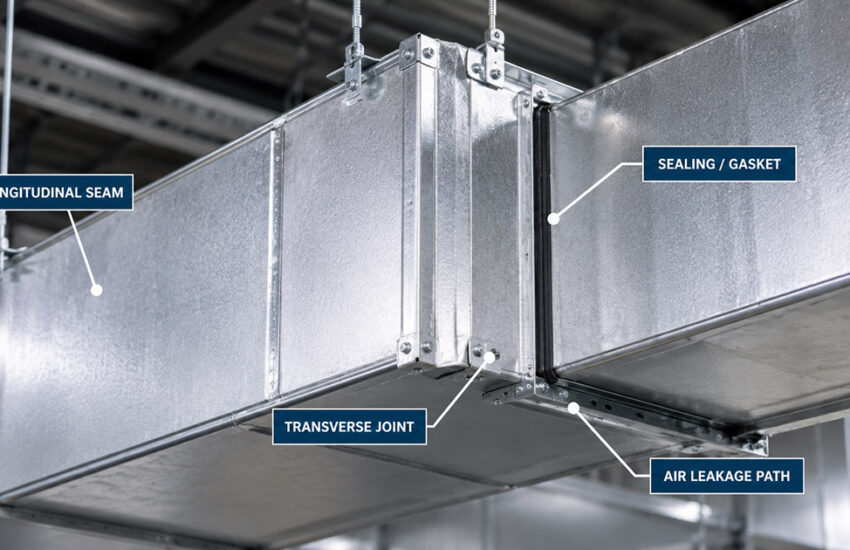
A longitudinal seam runs along the length of a duct section, while a transverse joint connects one duct section to another. These connections are repeated throughout a large HVAC installation, meaning even small imperfections can become significant when multiplied across hundreds of joints.
Other potential leakage locations include access doors, branch connections, equipment connections, penetrations and damper openings.
This is why duct manufacturing should not be viewed simply as cutting, bending and assembling sheet metal. The quality of every connection contributes to the overall performance of the finished system.
Why Duct Joints Matter
A transverse joint is where two duct sections come together. Depending on the duct construction, this connection may incorporate flanges, gaskets, cleats, bolts, corners and sealants.
If the mating surfaces are not properly aligned or the connection is not adequately sealed, air can escape through the joint when the duct is pressurized.
The problem becomes more important as system pressure increases. A small opening that appears insignificant at low pressure can allow a greater amount of air to escape when the system operates at higher pressure.
ASHRAE notes that duct leakage is affected by variables including fabrication and installation methods, while good-quality ductwork and proper post-installation sealing can contribute to energy savings and improved delivery of ventilation air.
The Role of Longitudinal Seams
Longitudinal seams are another critical part of duct construction.
These seams run in the direction of airflow and are formed when sheet metal is shaped into a duct section. The type of seam, its dimensional accuracy and the quality of its formation can influence the potential for leakage.
Modern duct manufacturing processes increasingly focus on improving seam consistency and reducing opportunities for leakage. SMACNA has highlighted manufacturing approaches designed to reduce leakage at locations where longitudinal seams meet transverse joints.
For a duct manufacturer, this reinforces an important principle: precision during fabrication can have a direct impact on the final air-tightness of the duct system.
Sealing Is More Than Applying Sealant
When people talk about reducing duct leakage, sealing is often the first solution that comes to mind. But effective sealing begins with the quality of the joint itself.
A poorly aligned or poorly fabricated joint cannot always be corrected simply by applying more sealant.
The manufacturing process should provide:
- Accurate duct dimensions
- Properly formed seams
- Correct flange alignment
- Consistent joint construction
- Proper corner formation
- Appropriate reinforcement
- Suitable sealing provisions
ASHRAE recommends sealing ductwork and plenum transverse joints, longitudinal seams and penetrations. It also emphasizes that openings and connections should be treated in a way that minimizes leakage while accommodating functional requirements such as thermal movement.
What Happens When Ducts Leak?
The consequences of leakage can extend beyond the duct itself.
When conditioned supply air escapes before reaching the intended terminal, the HVAC system may need to compensate by moving more air or operating differently to achieve the required conditions.
ASHRAE notes that supply-air leakage can reduce cooling and dehumidification capacity delivered to conditioned spaces and can affect HVAC energy use.
Leakage can also affect air balancing. If the system is designed to deliver a particular airflow but some of that air escapes through joints and seams, the actual airflow available downstream may be lower than expected.
This can create complaints such as uneven cooling, inadequate ventilation or difficulty achieving design airflow at distant terminals.
Leakage Can Also Create Moisture Problems
The issue is not limited to energy and airflow.
In certain applications, leaking duct connections can contribute to moisture-related problems. For example, cold air escaping from a supply duct can cool nearby surfaces, potentially creating conditions where condensation occurs in humid environments.
Similarly, negative-pressure ductwork can draw untreated humid air into concealed spaces through leaking connections.
ASHRAE has specifically highlighted the relationship between duct connection leakage, humid-air infiltration and moisture-related building problems.
Why Manufacturing Quality Matters
This is where the role of the duct manufacturer becomes particularly important.
A duct system is assembled from many individual components, and every component has to work as part of the larger system. Consistency in fabrication can therefore make a substantial difference.
At DUCTTECH INFRABUILD PRIVATE LIMITED, the manufacturing approach focuses on producing HVAC ductwork according to project drawings, specifications and application requirements.
The objective is not simply to manufacture duct sections, but to maintain attention to fabrication accuracy, joint construction, reinforcement and overall product quality.
For commercial and industrial HVAC projects, this becomes particularly important where large quantities of rectangular, round, spiral or customized ductwork are required.
Air Leakage Testing and Quality Control
Visual inspection is useful, but it cannot always identify every potential leakage path.
For projects with specified leakage requirements, duct leakage testing provides a more measurable way to evaluate system performance. SMACNA’s HVAC Air Duct Leakage Test Manual covers leakage criteria, testing procedures, test equipment and methods for evaluating ductwork leakage.
Testing requirements should be established according to the project’s specifications, applicable standards and pressure classification.
A professional manufacturing and installation process should therefore consider air leakage from the beginning rather than treating testing as an afterthought.
The Bigger Picture
Duct joints and seams may appear to be small details in a large HVAC installation, but they can have an outsized influence on system performance.
A well-designed duct system still depends on well-manufactured and properly sealed connections. Accurate fabrication, consistent seams, properly constructed joints and appropriate sealing all contribute to reducing unwanted air loss.
For DUCTTECH INFRABUILD PRIVATE LIMITED, this highlights an important aspect of duct manufacturing: quality is not only about how a duct looks when it leaves the factory—it is about how reliably it performs after it becomes part of the HVAC system.
As HVAC systems become increasingly focused on energy efficiency, indoor comfort and controlled airflow, attention to duct joints and seams will remain an essential part of professional duct manufacturing.


