
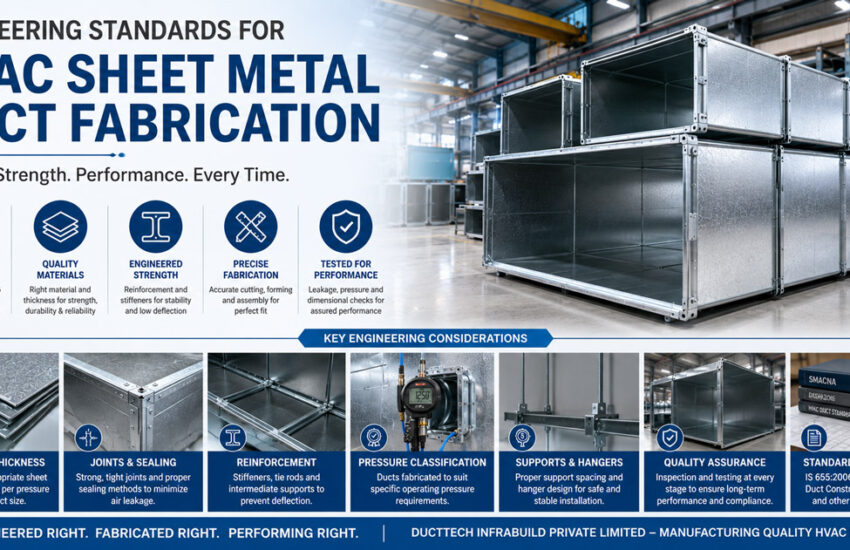
Engineering Standards for HVAC Sheet Metal Duct
An HVAC duct may look like a straightforward sheet-metal product, but behind every properly manufactured duct is a combination of engineering calculations, material specifications, fabrication practices and industry standards.
From sheet thickness and reinforcement to joints, pressure classification, supports and air leakage, every detail can influence how a duct performs after installation. This is why engineering standards play such an important role in HVAC sheet metal duct fabrication.
For contractors, consultants and building owners, understanding these standards also provides a useful way to evaluate whether a duct manufacturer is producing ductwork according to recognized engineering requirements.
Why Engineering Standards Matter in Duct Fabrication
HVAC ducts are expected to perform under specific operating conditions for many years. They must withstand internal pressure, maintain their shape, support their own weight and, where applicable, limit unwanted air leakage.
Without defined construction requirements, duct fabrication could vary considerably from one manufacturer or project to another.
Engineering standards provide a structured framework for determining how ductwork should be designed, fabricated and installed.
In India, IS 655:2006, Specification for Air Ducts, covers materials and construction requirements for air ducts used in air-conditioning, ventilation and gas-exhausting systems.
The 2024 CPWD HVAC specifications also reference IS 655:2006, reaffirmed in 2022, and SMACNA standards for duct material and construction requirements.
SMACNA: A Major Reference for HVAC Duct Construction
One of the most widely recognized references for sheet metal HVAC duct construction is the SMACNA HVAC Duct Construction Standards – Metal and Flexible.
The current fourth edition, ANSI/SMACNA 006-2020, represents SMACNA’s latest edition of its flagship HVAC duct construction standard. It covers duct construction and installation requirements and includes guidance for rectangular, round, oval and flexible duct systems.
The standard addresses areas such as:
- Duct pressure classifications
- Sheet-metal thickness
- Rectangular duct construction
- Round and oval duct construction
- Reinforcement
- Joints
- Fittings
- Hangers and supports
- Sealants
- Double-wall duct construction
- Accessories
- Functional performance requirements
For a duct manufacturer, these requirements provide an engineering framework rather than simply a fabrication checklist.
IS 655 and Its Importance in India
For projects in India, IS 655 is particularly relevant because it specifically addresses metal air ducts.
The standard covers materials and construction requirements for ducts used in air-conditioning, ventilation and gas-exhausting systems.
The latest CPWD HVAC specification further demonstrates how Indian projects can incorporate IS 655 alongside SMACNA requirements. CPWD’s 2024 specification states that duct construction should generally follow IS 655 or SMACNA unless the project specification requires otherwise.
This is important because the applicable requirement ultimately depends on the project specification, authority having jurisdiction and contractual requirements.
Sheet Thickness Is More Than a Material Selection
One of the most visible aspects of duct fabrication is sheet thickness, but selecting the thickness is an engineering decision rather than simply choosing a heavier or lighter sheet.
Duct dimensions, pressure, construction method, reinforcement and material all influence the appropriate construction.
For example, a large rectangular duct has relatively broad flat panels. Without adequate stiffness and reinforcement, these panels can deflect under pressure.
SMACNA’s construction approach provides combinations of duct dimensions, sheet thickness and reinforcement for different pressure conditions. ASHRAE also describes rectangular duct construction in terms of duct thickness, reinforcement and maximum spacing between reinforcement members.
The objective is to achieve the required structural performance without unnecessarily increasing material consumption and weight.
Reinforcement and Structural Stability
Reinforcement is another critical element of professional duct fabrication.
As duct dimensions increase or operating pressures become more demanding, additional reinforcement may be required to control panel deflection and maintain structural stability.
Reinforcement can involve formed features, transverse reinforcement, intermediate structural members, tie rods or other approved construction methods depending on the duct design.
ASHRAE notes that rectangular duct construction includes combinations of thickness, reinforcement and maximum reinforcement spacing, with intermediate structural members and tie rods used where necessary.
This makes reinforcement an engineering consideration rather than merely a fabrication detail.
Joints and Seams Affect Performance
A duct system contains numerous longitudinal seams and transverse joints. Their construction can influence structural strength as well as air leakage.
Poorly aligned joints, inconsistent fabrication or inadequate sealing can create potential leakage paths.
The SMACNA 2020 standard includes requirements and guidance covering duct joints, sealants and construction methods. Its fourth edition also introduced additional information on spray and aerosolized duct sealants and updated requirements for several duct components.
For manufacturers, this reinforces the importance of precision during fabrication.
Pressure Classification Must Be Considered
Not every HVAC duct operates at the same pressure.
A low-pressure comfort-air system and a high-pressure industrial ventilation system can impose very different structural demands on ductwork.
Pressure classification therefore affects construction decisions such as sheet thickness, reinforcement, joints and sealing.
ASHRAE’s current duct construction guidance identifies pressure classification as a key part of duct construction and notes that rectangular steel duct requirements include thickness, reinforcement and support considerations.
A professional duct manufacturer should therefore receive clear information about the required pressure class before fabrication begins.
Hangers and Supports Are Part of the System
A duct is not structurally independent once it leaves the manufacturing facility. It becomes part of a suspended system supported by hangers, rods, brackets and other components.
Improper support spacing or inadequate support construction can place additional loads on the duct and its joints.
SMACNA’s current standard includes updated requirements relating to duct hangers and supports, demonstrating that installation support is considered part of overall duct system performance.
This is why duct manufacturing and installation should be considered together during project planning.
Material Selection Depends on the Application
GI steel is widely used for conventional HVAC ductwork, but other materials may be required depending on the environment.
Aluminium, stainless steel and other materials can be selected for applications involving particular corrosion, cleanliness, weight or environmental requirements.
ASHRAE notes that galvanized steel, uncoated carbon steel and aluminium are commonly used for industrial air handling, while material selection should be carefully considered for corrosive gases, vapours, mists and high-temperature applications.
The correct material therefore depends on the actual operating environment rather than a one-size-fits-all approach.
DUCTTECH INFRABUILD and Standards-Based Manufacturing
For DUCTTECH INFRABUILD PRIVATE LIMITED, engineering standards provide an important reference point for manufacturing HVAC ductwork according to project requirements.
The company’s duct manufacturing approach can incorporate considerations such as:
- Project drawings and specifications
- Duct dimensions
- Material selection
- Sheet thickness
- Pressure classification
- Reinforcement
- Joint construction
- Sealing requirements
- Supports and installation conditions
- Application-specific requirements
This project-oriented approach is particularly important for commercial buildings, industrial facilities and large HVAC installations where ductwork can involve thousands of individually fabricated sections.
Quality manufacturing is not simply about producing ducts with accurate dimensions. It involves understanding how the finished duct is expected to perform.
Standards and Project Specifications Must Work Together
An important point for contractors and consultants is that no single standard should automatically be assumed to govern every project.
Applicable building codes, local requirements, project specifications, referenced standards and authority requirements all need to be considered.
ASHRAE notes that building codes and standards can be developed and adopted on different schedules, meaning the applicable edition and local requirements need to be established for the specific project.
In India, this is particularly relevant because CPWD specifications may reference IS 655 and SMACNA together, while individual projects may introduce additional requirements.
The Bigger Picture
Engineering standards bring consistency to HVAC sheet metal duct fabrication.
They help define how duct dimensions, materials, pressure, reinforcement, joints, sealing and supports should be considered so that the finished system can deliver the performance expected by the designer.
For DUCTTECH INFRABUILD PRIVATE LIMITED, following recognized engineering practices is part of a broader commitment to manufacturing quality HVAC ductwork for commercial and industrial applications.
Ultimately, the quality of a duct is determined by more than the appearance of its sheet metal. It is the combination of engineering, material selection, fabrication accuracy, reinforcement, joints and workmanship that determines how reliably the duct performs once it becomes part of an operating HVAC system.


