
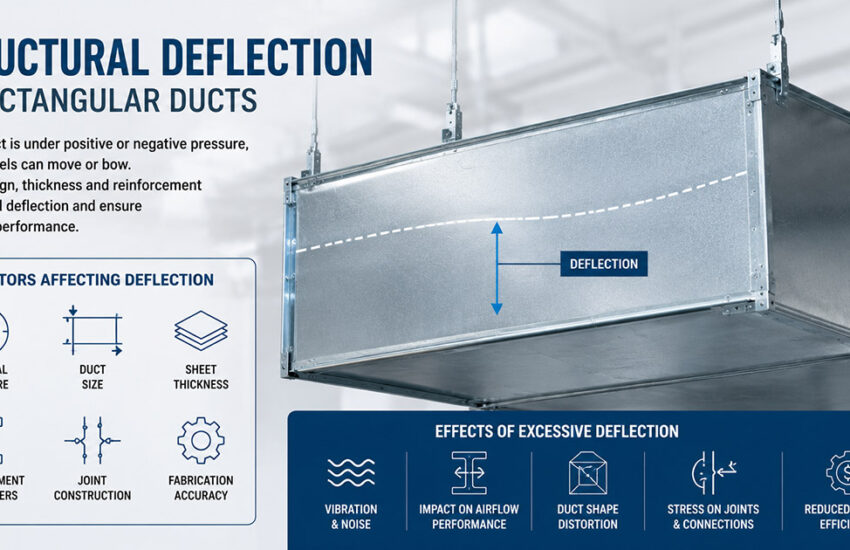
What is Structural Deflection in Rectangular Ducts?
Look closely at a large rectangular HVAC duct and its broad sheet-metal panels may appear perfectly rigid. But once the duct is operating, the pressure difference between the inside and outside can cause those panels to move slightly. This movement is known as structural deflection.
While a small amount of movement can be expected within an engineered duct system, excessive deflection can indicate that the duct construction is not adequately matched to its operating conditions. For HVAC designers, contractors and duct manufacturers, controlling deflection is therefore an important part of achieving reliable rectangular ductwork.
The subject has long been addressed in industry standards. SMACNA’s duct construction standards consider duct wall deflection alongside pressure, sheet thickness, duct dimensions and reinforcement. Its testing and analysis have shown that the structural behaviour of rectangular ducts can be predicted based on these factors.
What Does Structural Deflection Mean?
Structural deflection is the amount by which a duct panel or component moves away from its original position when subjected to a load.
In rectangular ductwork, the most common load is the pressure difference across the duct wall.
When air moves through a duct, the internal pressure may be higher or lower than the surrounding atmospheric pressure. This creates a force on the sheet-metal panels.
A rectangular panel is relatively flat compared with a round duct. As a result, its large flat surfaces can be more susceptible to bending or bowing when exposed to pressure.
The amount of movement depends on several factors, including duct width, panel thickness, pressure, reinforcement arrangement and construction details.
Why Are Rectangular Ducts More Sensitive to Deflection?
The geometry of a rectangular duct is one of the key reasons structural deflection requires attention.
Round ducts naturally distribute pressure around their curved walls. Rectangular ducts, on the other hand, contain relatively large flat panels.
As the width of a rectangular duct increases, the unsupported panel area can also increase. If the sheet thickness and reinforcement are not appropriately selected, the panel may show greater movement under pressure.
This does not mean that rectangular ducts are unsuitable for high-pressure or large HVAC systems. Rather, their construction needs to be engineered according to the required operating conditions.
SMACNA’s standards specifically relate duct construction to pressure class, duct size, sheet thickness, joints and reinforcement, treating these components as an integrated assembly.
What Causes Structural Deflection?
Several factors can contribute to deflection in rectangular ductwork.
1. Internal Static Pressure
Pressure is one of the primary factors. Higher positive or negative pressure can place greater loads on duct panels.
A duct designed for a particular pressure class needs construction appropriate for that operating condition.
2. Duct Size
Larger duct panels generally require greater attention to structural stiffness.
As duct width increases, the unsupported area of the sheet can become larger. This can increase the potential for panel movement if reinforcement and material thickness are not properly selected.
3. Sheet Thickness
The thickness of the duct sheet has a direct relationship with its stiffness.
A thinner panel generally requires more careful reinforcement and spacing considerations, while a thicker panel can provide greater inherent rigidity.
SMACNA’s published relationships indicate that, for a constant duct size and pressure, thicker sheet can permit greater reinforcement spacing, while thinner sheet generally requires closer reinforcement.
4. Reinforcement and Stiffeners
Reinforcement is used to improve the structural stability of duct panels.
Depending on the design, reinforcement may be incorporated at joints or between joints. Stiffeners, formed features and other reinforcement arrangements can help control panel movement.
However, reinforcement should not be considered independently from the rest of the duct construction. SMACNA notes that duct wall thickness, joints, reinforcement and supports form an integrated construction system.
5. Fabrication Accuracy
Even a technically appropriate design can be affected by inconsistent fabrication.
Incorrect dimensions, poorly formed components, inaccurate reinforcement placement or improper joint construction can affect the final structural performance of the duct.
This makes manufacturing quality an important part of deflection control.
Why Excessive Deflection Can Be a Problem
Structural deflection is not simply an aesthetic concern.
Excessive panel movement can affect the appearance and dimensional stability of ductwork and may contribute to vibration or other performance issues.
Duct construction standards consider dimensional stability, deflection and vibration among the functional performance characteristics that need to be addressed in duct design and construction.
In severe cases, inadequate structural design can also affect joints, reinforcement and connections.
For this reason, ductwork should be designed and manufactured to remain within the performance requirements established for the project.
How Is Deflection Controlled?
Controlling structural deflection starts with selecting the appropriate construction for the expected operating conditions.
The process generally involves considering:
- Duct dimensions
- Operating pressure
- Pressure class
- Sheet thickness
- Joint construction
- Reinforcement type
- Reinforcement spacing
- Supports and hangers
- Material properties
- Fabrication requirements
The objective is not simply to make the duct heavier. Over-engineering can increase material use, weight and cost without necessarily providing the most efficient solution.
Instead, the construction should be selected to achieve the required structural performance for the particular application.
The Importance of SMACNA-Based Construction
SMACNA has developed widely recognized technical standards for duct construction, including its HVAC Duct Construction Standards – Metal and Flexible and Rectangular Industrial Duct Construction Standards. SMACNA’s current technical standards include a fourth edition of its HVAC duct construction standard and a third edition of its rectangular industrial duct construction standard.
The latest rectangular industrial duct standard also includes expanded pressure-capacity tables and additional stiffener-spacing options for different materials and larger duct panels.
These standards provide designers, contractors and manufacturers with structured approaches for selecting duct construction based on pressure, dimensions, materials and reinforcement.
DUCTTECH INFRABUILD and Rectangular Duct Manufacturing
For a duct manufacturer, controlling structural deflection begins long before the finished duct reaches the installation site.
At DUCTTECH INFRABUILD PRIVATE LIMITED, rectangular duct manufacturing focuses on fabrication according to project drawings, specifications and required construction details.
Important manufacturing considerations include accurate dimensions, proper sheet selection, correctly formed joints, appropriate reinforcement and consistent fabrication.
For large commercial and industrial HVAC projects, these details become particularly important because thousands of individual duct sections may ultimately become part of a single air-distribution system.
The goal is to produce ductwork that is not only dimensionally accurate but also appropriate for its intended operating conditions.
A Small Movement With a Bigger Engineering Lesson
Structural deflection may appear to be a minor movement in a sheet-metal panel, but it represents a larger engineering principle: ductwork must be designed as a structural system, not simply as an airflow passage.
Pressure, duct dimensions, sheet thickness, reinforcement and fabrication quality all work together to determine how a rectangular duct behaves during operation.
For contractors, consultants and building owners, understanding this relationship can help in selecting appropriate duct construction and manufacturing partners.
For manufacturers such as DUCTTECH INFRABUILD PRIVATE LIMITED, it reinforces the importance of precision fabrication and project-specific construction.
Ultimately, good rectangular duct manufacturing is about more than producing a box-shaped sheet-metal component. It is about creating a duct system capable of maintaining its intended shape, strength and performance under the conditions for which it was designed.


