
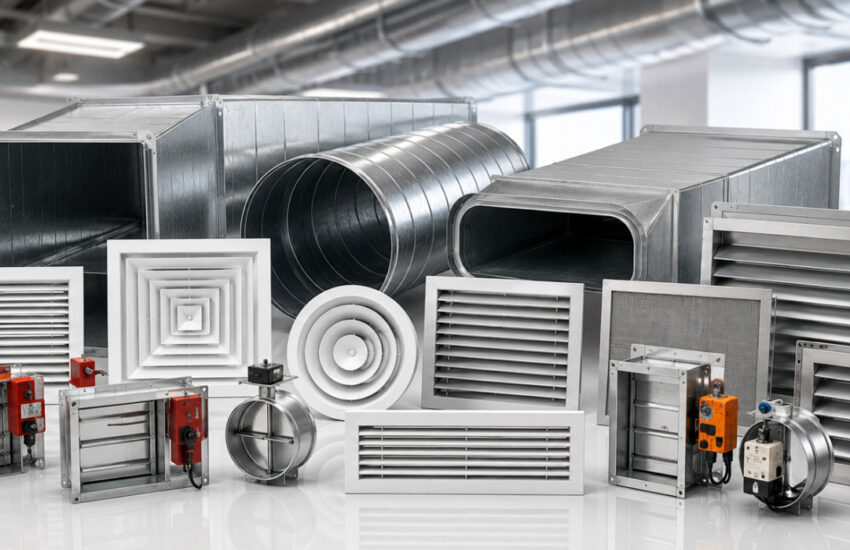
Air Distribution Components: Essential Products That Power
Introduction
Every modern building depends on an efficient HVAC system to provide comfortable temperatures, healthy indoor air, and consistent ventilation. While air conditioning units and air handling equipment often receive the most attention, the performance of the entire system largely depends on the quality of its air distribution components.
Air distribution components regulate, direct, balance, and control the movement of conditioned air throughout a building. From ducts and diffusers to grilles, dampers, and louvers, each component plays a specific role in ensuring that air reaches every occupied space efficiently.
As commercial construction, healthcare infrastructure, data centers, hospitality projects, and industrial facilities continue to grow across India, demand for precision-engineered air distribution components is increasing rapidly.
What Are Air Distribution Components?
Air distribution components are the products that work together to deliver conditioned air from an HVAC system into occupied spaces while maintaining proper airflow, pressure, temperature, and indoor air quality.
A complete HVAC air distribution system includes several engineered products that ensure efficient air movement throughout the building.
These components not only improve airflow but also contribute to energy savings, noise reduction, fire safety, and occupant comfort.
Why Air Distribution Components Are Important
Even the most advanced HVAC equipment cannot perform efficiently without properly designed air distribution products.
High-quality components help achieve:
- Uniform airflow throughout the building
- Better indoor air quality
- Lower energy consumption
- Reduced operating costs
- Improved occupant comfort
- Longer HVAC equipment life
- Easier maintenance
- Better architectural aesthetics
When all components work together, the HVAC system delivers reliable performance for years.
Major Air Distribution Components
HVAC Ducts
Ducts form the backbone of every HVAC air distribution system.
They transport conditioned air from the air handling unit to different parts of a building.
Common duct types include:
Proper duct design minimizes pressure loss and ensures efficient airflow.
Air Grilles
Air grilles are installed at supply and return air openings.
Their primary function is to control airflow while providing an attractive architectural finish.
Popular types include:
- Supply Air Grilles
- Return Air Grilles
- Single Deflection Grilles
- Double Deflection Grilles
- Egg Crate Grilles
- Linear Grilles
Modern grilles are available in aluminium, galvanized steel, and stainless steel.
Air Diffusers
Diffusers distribute conditioned air evenly throughout occupied spaces.
Unlike standard grilles, diffusers are designed to spread air in multiple directions while reducing drafts.
Common diffuser options include:
- Square Ceiling Diffusers
- Circular Diffusers
- Linear Slot Diffusers
- Swirl Diffusers
- Jet Diffusers
Proper diffuser selection improves comfort while maintaining balanced airflow.
Volume Control Dampers (VCD)
Volume Control Dampers regulate airflow inside HVAC ducts.
They help HVAC engineers balance air quantities supplied to different rooms.
Benefits include:
- Air balancing
- Improved efficiency
- Reduced energy consumption
- Better system control
Fire Dampers
Fire dampers improve building safety by preventing fire and smoke from spreading through ductwork.
They automatically close when exposed to high temperatures.
Fire dampers are mandatory in many commercial and institutional buildings to comply with fire safety regulations.
Motorized Dampers
Motorized dampers automatically regulate airflow using electric actuators.
These dampers are widely used in:
- Smart buildings
- Building Management Systems (BMS)
- Energy-efficient HVAC installations
Back Draft Dampers
Back draft dampers prevent reverse airflow when fans or ventilation equipment are switched off.
They improve HVAC efficiency while protecting equipment.
Louvers
Louvers allow fresh air intake and exhaust while preventing rainwater, insects, birds, and debris from entering HVAC systems.
Common types include:
- Weather Louvers
- Fresh Air Louvers
- Sand Trap Louvers
- Acoustic Louvers
Applications of Air Distribution Components
These products are used in almost every modern building, including:
- Commercial offices
- Shopping malls
- Hospitals
- Hotels
- Airports
- Pharmaceutical facilities
- Manufacturing plants
- Warehouses
- Educational institutions
- Residential apartments
- Data centers
Each project requires carefully selected components based on airflow requirements and building design.
Factors to Consider When Selecting Air Distribution Components
Choosing the right components requires careful evaluation of several factors.
Material Quality
High-grade aluminium, galvanized steel, and stainless steel offer superior durability and corrosion resistance.
Airflow Performance
Products should be engineered to minimize pressure loss while maintaining efficient air distribution.
Noise Levels
Low-noise components enhance occupant comfort in offices, hospitals, hotels, and educational facilities.
Fire Safety
Products should comply with applicable HVAC and fire safety standards.
Customization
Modern buildings often require customized sizes, finishes, blade configurations, and mounting options.
Manufacturing Quality
Precision fabrication ensures better installation, reduced air leakage, and long-term reliability.
Benefits of High-Quality Air Distribution Components
Investing in premium HVAC products provides long-term advantages, including:
- Better airflow control
- Higher energy efficiency
- Lower maintenance costs
- Improved indoor air quality
- Extended HVAC equipment life
- Reduced operating expenses
- Enhanced occupant comfort
- Improved building aesthetics
These benefits make quality components a cost-effective investment for commercial and industrial projects.
Future Trends in Air Distribution Components
The HVAC industry continues to evolve with advancements in technology and sustainable construction.
Emerging trends include:
- Smart airflow monitoring
- IoT-enabled HVAC controls
- High-efficiency diffusers
- Low-pressure-loss duct systems
- Sustainable manufacturing practices
- BIM-compatible product design
- Energy-efficient air balancing solutions
Manufacturers are increasingly focusing on products that improve efficiency while reducing environmental impact.
Conclusion
Air distribution components are the foundation of every efficient HVAC system. Although often overlooked, products such as ducts, grilles, diffusers, dampers, and louvers determine how effectively conditioned air reaches occupied spaces.
Selecting precision-engineered, high-quality components improves energy efficiency, enhances indoor comfort, supports better air quality, and extends the life of HVAC equipment. Whether for commercial buildings, hospitals, industrial facilities, or residential developments, investing in reliable air distribution components ensures long-term HVAC performance and operational efficiency.


