
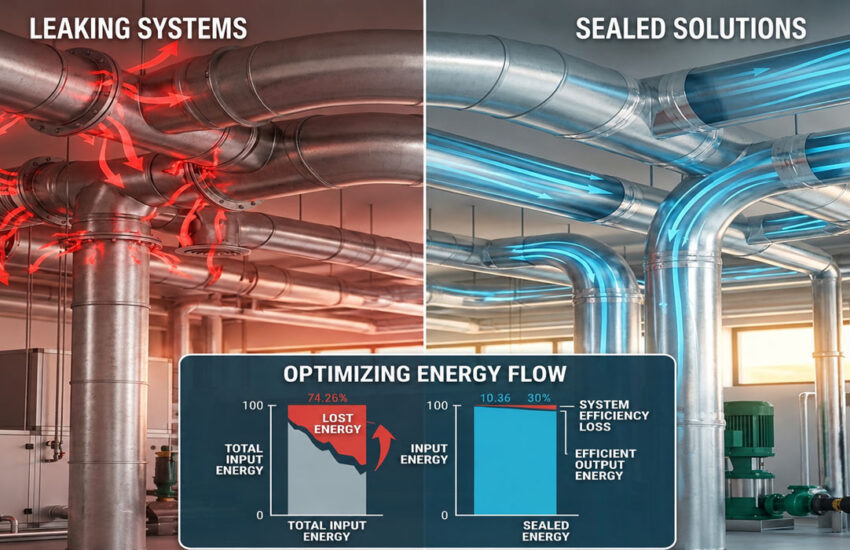
Air Leakage in Duct Systems: Causes and
The Hidden Problem That Can Significantly Impact HVAC Performance
When building owners notice rising energy bills, uneven room temperatures, poor airflow, or declining HVAC performance, they often assume the problem lies with the air conditioning equipment itself. However, in many commercial and industrial facilities, the real culprit is much less visible—air leakage within the duct system.
Ductwork serves as the delivery network for conditioned air. Whether in an office building, shopping mall, hospital, warehouse, hotel, or manufacturing plant, ducts are responsible for transporting cooled, heated, or ventilated air to occupied spaces. When leaks occur, a portion of that conditioned air escapes before reaching its intended destination.
The result is wasted energy, increased operating costs, reduced comfort, and unnecessary strain on HVAC equipment.
As organizations focus more on energy efficiency and sustainable building operations, controlling air leakage has become one of the most important priorities in HVAC system design, fabrication, and installation.
What Is Air Leakage in Duct Systems?
Air leakage occurs when conditioned air escapes through gaps, cracks, improperly sealed joints, damaged duct sections, or poorly connected components within a duct network.
Instead of reaching occupied spaces, the escaped air is lost into ceilings, service shafts, plant rooms, or unconditioned areas.
While a small amount of leakage may seem insignificant, the cumulative impact across an entire building can be substantial. In large commercial facilities, even minor leaks distributed throughout the duct network can result in considerable energy losses over time.
The problem becomes even more severe in high-pressure HVAC systems where air is constantly being pushed through extensive duct runs.
Why Air Leakage Matters
Many building owners underestimate the consequences of duct leakage.
However, the effects extend far beyond higher electricity bills.
Increased Energy Consumption
When conditioned air escapes through leaks, HVAC equipment must work harder to maintain desired indoor temperatures.
This additional workload increases energy usage and operating costs.
The HVAC system effectively compensates for lost air by running longer and consuming more power.
Uneven Indoor Comfort
Leaking ducts often cause inconsistent airflow throughout a building.
Some rooms may receive insufficient cooling or heating while others remain comfortable.
Occupants frequently experience:
- Hot spots
- Cold spots
- Uneven temperatures
- Poor ventilation
These comfort issues can negatively affect employee productivity and customer satisfaction.
Reduced HVAC Equipment Lifespan
When systems operate under increased load conditions for extended periods, equipment experiences greater wear and tear.
Compressors, fans, motors, and other critical components may fail prematurely, leading to increased maintenance and replacement costs.
Poor Indoor Air Quality
Leaks can allow contaminants from unconditioned spaces to enter the duct system.
Dust, insulation particles, moisture, and pollutants may be drawn into the airflow stream, affecting indoor air quality and occupant health.
This is particularly concerning in healthcare facilities, laboratories, pharmaceutical plants, and food processing environments.
Common Causes of Air Leakage
Understanding the root causes of leakage is the first step toward preventing it.
Poorly Sealed Joints and Connections
One of the most common sources of leakage is improperly sealed duct joints.
Every connection point in a duct system represents a potential leakage location if sealing materials are inadequate or incorrectly applied.
Over time, vibration and thermal expansion can further weaken poorly sealed joints.
Low-Quality Fabrication
Precision fabrication plays a crucial role in minimizing leakage.
Poorly manufactured duct sections may have:
- Inaccurate dimensions
- Gaps at connections
- Weak seams
- Improperly formed flanges
These defects create opportunities for conditioned air to escape.
High-quality fabrication significantly reduces leakage risks from the outset.
Improper Installation Practices
Even well-fabricated ducts can leak if installation quality is poor.
Common installation mistakes include:
- Misaligned duct sections
- Incomplete sealing
- Loose connections
- Damaged components during handling
Proper installation procedures are essential for maintaining system integrity.
Damaged Ductwork
Physical damage can occur during construction, renovation, maintenance, or routine facility operations.
Dents, punctures, corrosion, and structural deterioration may compromise duct performance and create leakage points.
Regular inspections help identify damage before it becomes a significant problem.
Aging Infrastructure
Older buildings often experience increasing duct leakage as materials age.
Sealants can deteriorate, joints may loosen, and metal components can corrode over time.
Without maintenance, leakage rates typically increase as HVAC systems age.
Signs Your Duct System May Be Leaking
Many facility managers do not discover duct leakage until performance problems become noticeable.
Common warning signs include:
- Rising energy bills
- Uneven room temperatures
- Weak airflow from diffusers
- Excessive HVAC operating hours
- Increased maintenance requirements
- Difficulty maintaining temperature settings
- Excessive dust accumulation
When these symptoms appear, a duct leakage assessment may be necessary.
How Air Leakage Is Measured
Modern HVAC professionals use specialized testing methods to evaluate duct system performance.
Leakage testing often involves:
- Duct pressure testing
- Airflow measurements
- Smoke testing
- Infrared thermal imaging
- Building commissioning procedures
These techniques help identify leakage locations and quantify overall system losses.
Leakage testing is particularly important in large commercial and industrial projects where efficiency requirements are stringent.
Effective Solutions for Air Leakage
Use High-Quality Fabrication Standards
Leakage prevention begins during manufacturing.
Precision fabrication helps ensure:
- Accurate dimensions
- Tight-fitting joints
- Proper flange construction
- Strong seam integrity
Manufacturers that follow recognized standards such as SMACNA typically produce duct systems with lower leakage rates.
Proper Sealing Techniques
All joints, seams, and connections should be sealed using approved materials.
Common sealing methods include:
- Duct sealants
- Gaskets
- Tapes designed for HVAC applications
- Mechanical fastening systems
Proper sealing significantly improves system efficiency.
Conduct Leakage Testing
Testing should not be viewed as an optional step.
Leakage testing verifies installation quality and identifies issues before building occupancy.
Early detection prevents long-term energy losses and costly corrective work.
Install Duct Supports Correctly
Improperly supported ducts can shift, sag, and create stress at joints.
Adequate support helps maintain alignment and preserve airtight connections throughout the system’s lifespan.
Perform Regular Maintenance
Routine inspections allow facility managers to identify and address developing issues before they become major problems.
Maintenance programs should include:
- Joint inspections
- Sealant condition checks
- Corrosion monitoring
- Damage assessments
Proactive maintenance reduces leakage and extends system life.
The Role of Spiral Ducts in Reducing Leakage
Many modern commercial and industrial facilities are adopting spiral duct systems because of their superior leakage performance.
Compared to traditional rectangular ducts, spiral ducts typically feature:
- Fewer joints
- Continuous seam construction
- Improved structural integrity
- Better pressure performance
These characteristics help reduce leakage opportunities while improving overall airflow efficiency.
As energy efficiency becomes increasingly important, spiral ducts continue to gain popularity across a wide range of HVAC applications.
The Future of Airtight HVAC Systems
Modern building standards increasingly emphasize energy conservation and sustainability.
Today’s HVAC systems are being designed with greater attention to:
- Airtight construction
- Energy-efficient airflow
- Advanced testing procedures
- High-performance fabrication methods
- Smart building monitoring technologies
Future duct systems will likely incorporate even more sophisticated leakage detection and performance monitoring capabilities.
Conclusion
Air leakage may be hidden behind ceilings and walls, but its impact on HVAC performance is impossible to ignore. From higher energy costs and reduced comfort to increased maintenance and equipment wear, leaking ducts can significantly affect building operations.
The good news is that most leakage problems are preventable through quality fabrication, professional installation, proper sealing, routine maintenance, and adherence to industry standards.
For commercial and industrial facilities, investing in airtight duct systems is one of the most effective ways to improve energy efficiency, enhance occupant comfort, and maximize the return on HVAC investments. In today’s competitive and sustainability-focused environment, controlling air leakage is no longer just a best practice—it is a business necessity.


