
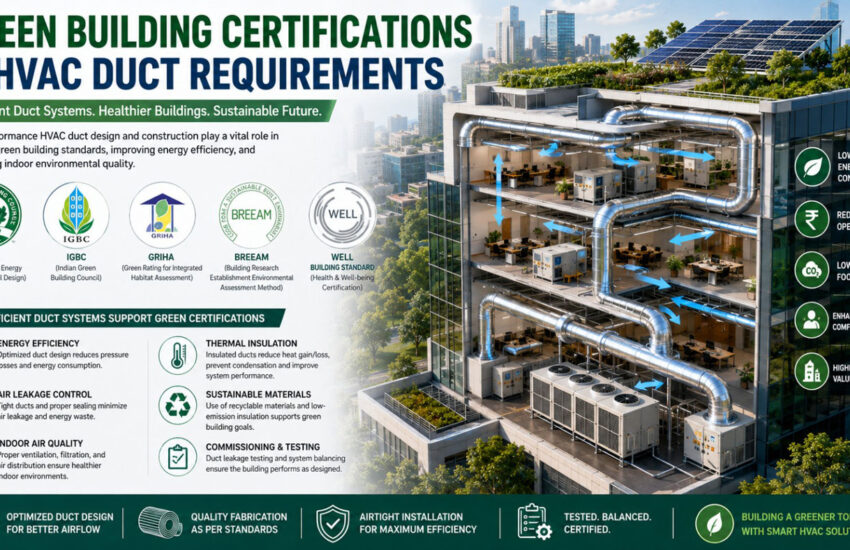
Green Building Certifications and HVAC Duct Requirements
Why HVAC Duct Systems Play a Critical Role in Sustainable Buildings
Sustainability is no longer a niche consideration in the construction industry. Today, developers, architects, engineers, and building owners are increasingly prioritizing environmentally responsible design practices that reduce energy consumption, lower carbon emissions, and create healthier indoor environments.
At the center of this movement are green building certifications—globally recognized frameworks that measure and reward sustainable building performance. While features such as solar panels, energy-efficient lighting, and water conservation systems often receive significant attention, HVAC systems remain one of the most influential contributors to certification success.
Within the HVAC ecosystem, ductwork plays a surprisingly important role.
Properly designed, fabricated, and installed duct systems contribute directly to energy efficiency, indoor environmental quality, occupant comfort, and overall building performance. As a result, HVAC duct requirements have become a critical consideration for projects pursuing green building certifications.
Understanding the relationship between sustainable construction standards and HVAC duct systems can help project teams maximize certification opportunities while improving long-term building performance.
The Rise of Green Building Certifications
Buildings account for a significant portion of global energy consumption and greenhouse gas emissions.
To encourage sustainable development, various certification programs have been established to evaluate and recognize environmentally responsible buildings.
Some of the most widely adopted green building certification systems include:
- LEED (Leadership in Energy and Environmental Design)
- IGBC (Indian Green Building Council)
- GRIHA (Green Rating for Integrated Habitat Assessment)
- BREEAM (Building Research Establishment Environmental Assessment Method)
- WELL Building Standard
Although each certification system has unique requirements, they share common objectives:
- Reduce energy consumption
- Improve indoor air quality
- Enhance occupant comfort
- Lower environmental impact
- Promote sustainable construction practices
HVAC systems play a major role in achieving these goals.
Why HVAC Systems Matter in Green Buildings
In most commercial buildings, HVAC systems represent the largest energy-consuming component.
Depending on building type and climate conditions, HVAC operations can account for 40% to 60% of total energy use.
Improving HVAC efficiency therefore has a direct impact on:
- Energy performance ratings
- Carbon emissions
- Operating costs
- Occupant health
- Sustainability metrics
While high-efficiency equipment is important, ductwork is equally critical because it determines how effectively conditioned air is distributed throughout the building.
Poor duct design can undermine the performance of even the most advanced HVAC equipment.
Energy Efficiency Begins with Duct Design
One of the primary objectives of green building certifications is reducing energy waste.
Proper duct design contributes to this objective by ensuring efficient airflow throughout the HVAC system.
Well-designed duct systems help:
- Minimize pressure losses
- Reduce fan energy consumption
- Improve airflow distribution
- Lower operating costs
- Enhance overall HVAC efficiency
When ducts are properly sized and routed, HVAC equipment can operate closer to its intended performance levels.
This improves energy efficiency and supports certification requirements related to building energy performance.
Air Leakage Control Is Essential
Air leakage is one of the most common causes of HVAC inefficiency.
Conditioned air that escapes through poorly sealed joints and connections never reaches occupied spaces, forcing HVAC equipment to work harder.
Green building certification programs increasingly emphasize airtight HVAC systems because leakage directly affects energy consumption.
To reduce leakage, projects typically focus on:
- High-quality duct fabrication
- Proper sealing methods
- Pressure testing
- Compliance with industry standards
- Professional installation practices
Lower leakage rates translate into improved energy performance and higher sustainability scores.
Duct Insulation Supports Energy Conservation
Insulated duct systems are another important component of sustainable building design.
When conditioned air travels through unconditioned spaces such as rooftops, service shafts, or mechanical rooms, heat gain and heat loss can occur.
Proper insulation helps:
- Maintain air temperature
- Reduce thermal losses
- Improve HVAC efficiency
- Lower energy costs
- Prevent condensation
Green building projects often incorporate insulated duct systems as part of their overall energy conservation strategy.
Indoor Air Quality Requirements
Modern green building standards place significant emphasis on indoor environmental quality.
Occupants spend a large percentage of their time indoors, making air quality a critical health consideration.
Proper duct systems contribute to healthier indoor environments by:
- Delivering adequate ventilation
- Supporting filtration performance
- Preventing contaminant infiltration
- Reducing dust accumulation
- Maintaining balanced airflow
Buildings with superior indoor air quality often experience improved occupant satisfaction, productivity, and wellness outcomes.
These benefits align closely with the objectives of certification programs such as LEED and WELL.
Ventilation Standards and Fresh Air Delivery
Many certification frameworks require buildings to meet strict ventilation standards.
Adequate fresh air delivery is essential for:
- Removing indoor pollutants
- Controlling carbon dioxide levels
- Improving occupant comfort
- Supporting healthy indoor environments
Duct systems must be carefully designed to distribute outdoor air efficiently throughout the building.
Improper airflow distribution can compromise ventilation effectiveness and negatively affect certification performance.
The Importance of Material Selection
Sustainable construction extends beyond energy efficiency.
The materials used in building systems also contribute to certification outcomes.
HVAC duct systems often incorporate materials that support sustainability objectives, including:
- Recyclable galvanized steel
- Stainless steel
- Low-emission insulation products
- Durable long-life components
Selecting environmentally responsible materials can contribute to certification credits related to resource efficiency and sustainable procurement.
The Growing Popularity of Spiral Duct Systems
Many modern green building projects utilize spiral duct systems because of their performance advantages.
Compared to traditional duct configurations, spiral ducts often provide:
- Lower air leakage rates
- Reduced pressure losses
- Improved airflow efficiency
- Faster installation
- Lower material usage
These characteristics support energy conservation goals and help improve overall HVAC system performance.
As sustainability requirements become more stringent, spiral duct systems are increasingly being specified in commercial and institutional projects.
Commissioning and Performance Verification
Green building certifications place strong emphasis on system verification.
Designing an efficient HVAC system is not enough—the system must also perform as intended.
Commissioning typically involves:
- Airflow testing
- Duct leakage testing
- Pressure verification
- Equipment performance evaluation
- Indoor air quality assessment
Performance verification helps ensure that sustainability objectives are achieved in real-world operating conditions.
Properly commissioned duct systems contribute significantly to building certification success.
Smart Buildings and Future Sustainability Goals
The future of green building design is closely linked to smart building technology.
Modern HVAC systems increasingly incorporate:
- Occupancy sensors
- Air quality monitoring
- Automated airflow controls
- Building management systems
- Real-time energy tracking
These technologies optimize HVAC performance while reducing energy waste.
However, even the most advanced control systems rely on properly designed duct infrastructure to distribute air effectively.
As green building standards continue to evolve, duct systems will remain a foundational component of sustainable building performance.
Why Choosing the Right Duct Manufacturer Matters
Achieving green building certification requires more than efficient design.
The quality of duct fabrication and installation directly affects system performance.
Experienced manufacturers help ensure:
- Accurate fabrication
- Reduced air leakage
- Compliance with industry standards
- Improved energy efficiency
- Long-term durability
For developers pursuing certification goals, partnering with a qualified duct manufacturer can significantly improve project outcomes.
Conclusion
Green building certifications have transformed how modern buildings are designed, constructed, and operated. While HVAC equipment often receives much of the attention, duct systems play an equally important role in achieving sustainability objectives.
From reducing air leakage and improving energy efficiency to enhancing indoor air quality and supporting ventilation requirements, properly designed ductwork contributes directly to certification success.
As developers and building owners continue to prioritize sustainability, HVAC duct systems will remain a critical element of high-performance building design. Investing in quality duct fabrication, insulation, airtight construction, and efficient airflow management is not only beneficial for certification purposes—it is essential for creating healthier, more efficient, and environmentally responsible buildings.


