
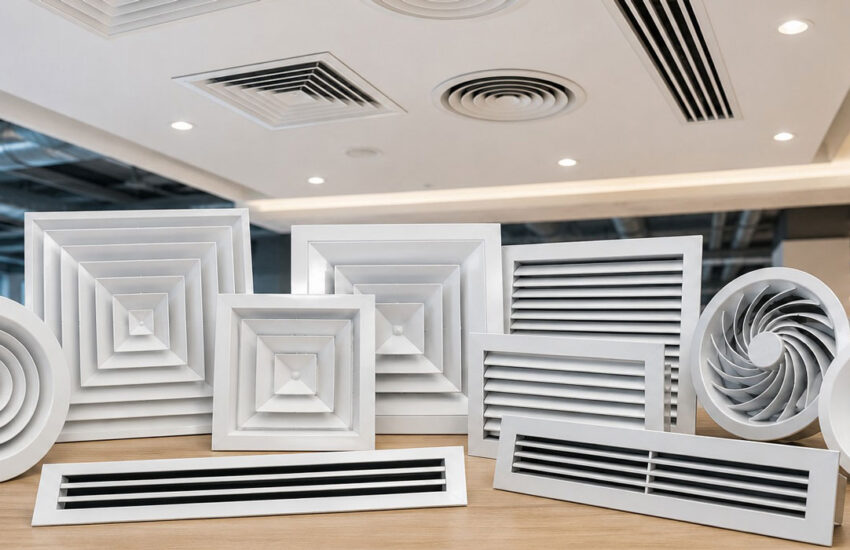
HVAC Grilles vs Diffusers: Understanding the Key
Introduction
In modern HVAC systems, delivering conditioned air efficiently is just as important as generating it. Whether it is a commercial office, hospital, hotel, shopping mall, industrial plant, or residential building, every HVAC installation depends on air terminal devices to ensure that cooled or heated air reaches occupants comfortably and efficiently. Among the most commonly used air distribution products are HVAC grilles and diffusers. While these two components are often mistaken for one another, they perform different functions and are designed for different airflow requirements.
Understanding the difference between HVAC grilles and diffusers is essential for architects, HVAC consultants, MEP engineers, contractors, and facility managers. Choosing the right product can improve indoor comfort, enhance energy efficiency, reduce noise, and ensure balanced airflow throughout a building.
This guide explains the key differences between HVAC grilles and diffusers, their applications, advantages, and how to select the right option for your project.
What Is an HVAC Grille?
An HVAC grille is an air terminal device designed to allow conditioned air to enter or leave a room while directing airflow in a specific direction. Grilles typically consist of fixed or adjustable blades arranged horizontally, vertically, or in a combination of both. They are installed on walls, ceilings, doors, or duct openings and are commonly used for both supply and return air applications.
Unlike diffusers, grilles are primarily intended to direct airflow rather than disperse it evenly across a space. Adjustable blade designs allow installers to fine-tune airflow direction during system balancing, making grilles a versatile solution for many commercial and residential HVAC systems.
Modern HVAC grilles are manufactured in aluminium, galvanized steel, and stainless steel, offering durability, corrosion resistance, and a clean architectural appearance.
What Is an HVAC Diffuser?
An HVAC diffuser is a specially engineered air outlet designed to distribute conditioned air evenly in multiple directions. Instead of directing airflow along a single path, diffusers create controlled air patterns that promote effective mixing between supply air and room air.
This improved air mixing helps maintain consistent temperatures, reduces drafts, and minimizes temperature stratification within occupied spaces. Diffusers are commonly installed in suspended ceilings and are available in square, circular, linear slot, swirl, and jet configurations.
Because of their ability to deliver balanced airflow, diffusers are widely used in offices, hospitals, hotels, airports, educational institutions, and other commercial buildings where occupant comfort is a priority.
Key Differences Between HVAC Grilles and Diffusers
Although both products are part of an HVAC air distribution system, their design and function differ significantly.
Airflow Pattern
The most noticeable difference lies in the way they handle airflow. Grilles direct air in one or two specific directions using fixed or adjustable blades, making them suitable for applications where targeted airflow is required. Diffusers, on the other hand, spread air evenly in multiple directions, creating a more uniform distribution throughout the room.
Purpose
Grilles are commonly used for both supply and return air, especially where airflow needs to be directed toward a particular area. Diffusers are primarily installed on supply air systems to ensure smooth and balanced air distribution.
Comfort
Because diffusers are engineered to reduce air velocity before it reaches occupants, they are generally more effective at minimizing drafts and maintaining thermal comfort. Grilles may produce more noticeable air streams if not properly selected or positioned.
Appearance
Architecturally, diffusers often blend seamlessly into modern ceiling systems, especially linear slot and square ceiling diffusers. Grilles provide a more traditional appearance and are frequently used on walls, doors, and exposed duct systems.
Types of HVAC Grilles
HVAC grilles are available in a wide range of designs to meet different airflow and installation requirements.
Single deflection grilles allow airflow adjustment in one direction and are commonly used where directional control is important.
Double deflection grilles provide adjustment in both horizontal and vertical directions, making them suitable for precise airflow balancing.
Return air grilles are designed to collect air from occupied spaces and return it to the HVAC system for filtration and conditioning.
Egg crate grilles offer low resistance to airflow and are commonly used in return air applications where maximum free area is required.
Linear bar grilles combine modern aesthetics with effective airflow control and are frequently specified in premium commercial interiors.
Types of HVAC Diffusers
Diffusers are designed to create specific airflow patterns based on the requirements of the space.
Square ceiling diffusers distribute air in four directions and remain the most widely used option in commercial buildings.
Linear slot diffusers provide long, continuous airflow patterns and complement contemporary architectural designs.
Circular diffusers distribute air radially and are suitable for open-plan spaces.
Swirl diffusers create rotational airflow that improves air mixing in large public buildings such as airports and auditoriums.
Jet diffusers are designed for long-throw applications, making them ideal for high ceilings, warehouses, and industrial facilities.
Applications of HVAC Grilles and Diffusers
Both products serve essential roles in HVAC systems, but their applications vary depending on airflow requirements and building design.
Grilles are commonly installed in offices, residential buildings, hotels, schools, industrial facilities, and return air systems where directional airflow or air extraction is required.
Diffusers are preferred in commercial offices, hospitals, conference rooms, shopping malls, airports, educational institutions, and hospitality projects where uniform air distribution and occupant comfort are critical.
In many HVAC systems, both grilles and diffusers are used together. Diffusers handle supply air distribution, while return air grilles collect air for recirculation, creating a balanced and efficient air distribution system.
How to Choose the Right Option
Selecting between grilles and diffusers depends on several factors, including room size, ceiling height, airflow volume, architectural design, and HVAC performance requirements.
Projects that require directional airflow or return air collection generally benefit from grilles. Spaces that prioritize occupant comfort, uniform temperature distribution, and reduced drafts are better served by diffusers.
Consulting an experienced HVAC manufacturer or design engineer ensures that the selected product meets both performance and aesthetic objectives.
Conclusion
The comparison between HVAC grilles vs diffusers is not about determining which product is better, but rather understanding which one is most suitable for a specific application. Grilles excel at directing and returning air, while diffusers are designed to distribute conditioned air evenly and comfortably throughout occupied spaces.
A well-designed HVAC system often combines both components to achieve balanced airflow, energy efficiency, and superior indoor comfort. By selecting high-quality products manufactured to precise standards, building owners, consultants, and contractors can ensure long-term HVAC performance and occupant satisfaction.


